
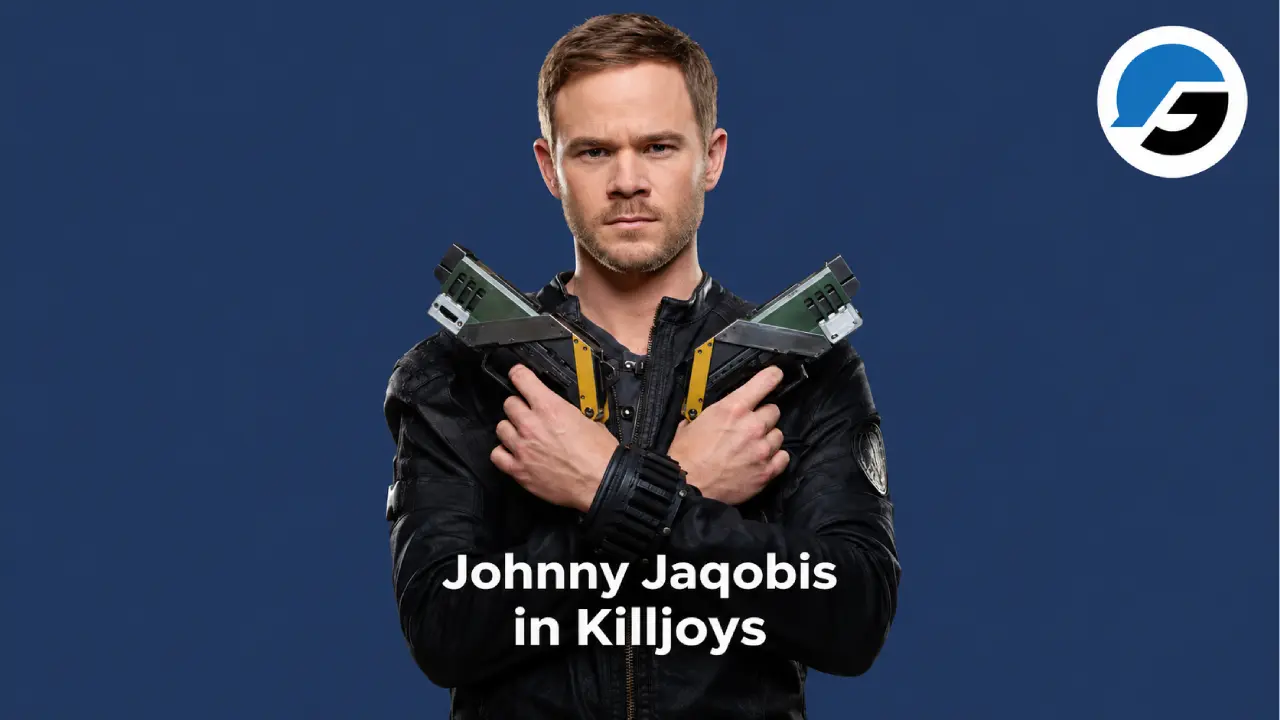
Johnny Jaqobis is the mechanic, pilot and bounty hunter played by Aaron Ashmore in Killjoys. He is Dutch’s long-standing partner and D’Avin’s younger brother, placing him between an established friendship and a family relationship that needs repair.
His technical ability gives him a practical role, but his temperament makes him distinctive. Johnny would generally prefer to talk through a problem before fighting, even though his profession repeatedly puts him in dangerous situations.
This guide focuses on the character’s foundations and relationships, without revealing the series finale.
What is Johnny’s place in the team?
Johnny is introduced as a Level 3 Killjoy. Dutch, the team’s leader, is a Level 5.
The opening distinction establishes different capabilities without making Johnny unimportant. Dutch has greater combat expertise, while Johnny contributes mechanical knowledge, piloting and a less confrontational approach.
The trio is not built around three interchangeable fighters. Its members bring different strengths and different reasons for responding to a problem.
Johnny’s skills are especially useful in a setting where machinery and travel are essential to the work. The team cannot carry out its assignments if it cannot get where it needs to go or keep its equipment functioning.
That gives him a clear responsibility before the audience understands every organisation and location in the fictional world.
Why his technical skills matter
Johnny is the team’s resident mechanic and pilot. Those responsibilities make him part of the action rather than someone waiting at the edge of it.
A mechanical failure can become an immediate problem when a job depends on transport, timing or access. Johnny’s work addresses those practical obstacles.
His role also gives the programme another route through a difficult situation. Not every problem has to be resolved by overpowering an opponent.
That is an interpretation of how the character functions within the ensemble. His established technical skills create possibilities that differ from the tactics a combat specialist might choose.
It also means his value is not measured only by whether he is the strongest person in a confrontation. The team’s success depends on a broader set of abilities.
Is Johnny a pacifist?
Johnny prefers to avoid unnecessary conflict, but calling him an absolute pacifist would be misleading.
He works as a bounty hunter and can fight when necessary. His reluctance concerns the choice to use violence, rather than a complete inability or refusal to act.
Early character descriptions present him as a peacemaker whose profession has nevertheless taught him how to defend himself.
That combination gives his decisions some tension. He may see the appeal of a calmer solution while working with people and circumstances that make it difficult to pursue.
His sarcasm adds another complication. Someone can dislike conflict without always avoiding the remark that draws him into it.
Johnny’s personality is therefore more specific than “the nice one”. Kindness, wit, practical competence and a willingness to act coexist in the same character.
What does Dutch mean to Johnny?
Dutch is Johnny’s long-standing partner and close friend. Their connection is built on shared work, trust and emotional support.
An early interview with Ashmore describes the relationship as important precisely because it has depth without being framed as a conventional romance.
That distinction matters. Emotional closeness between a man and a woman does not have to be explained as romantic attraction to carry weight in a story.
Dutch and Johnny depend on one another during dangerous assignments. Their partnership also gives each of them someone who understands more than the immediate job.
For Johnny, Dutch is therefore part of the structure of his life, not simply the person issuing instructions. Their history gives the partnership a familiarity that cannot be recreated by assigning someone else the same task.
It is also important that Dutch remains the leader. Their closeness does not erase her authority or turn the team into a group without clear responsibilities.
How does D’Avin complicate Johnny’s life?
D’Avin is Johnny’s older brother, but their family connection does not make their relationship easy. They are estranged when the series begins.
Johnny wants to communicate and rebuild the connection. D’Avin is more guarded, leaving them with different levels of readiness for that repair.
Ashmore discussed those foundations in an early interview about Johnny’s relationships. He described affection existing alongside resentment and friction between the brothers.
That gives Johnny a different problem from the one he faces at work. A malfunctioning machine can have a fault to identify and repair; another person may not be ready to explain what is wrong.
The comparison is an editorial reading, but it helps clarify the character’s position. His practical confidence does not give him complete control over his most important relationships.
Friendship and family pull him in different directions
Johnny begins with an established partnership with Dutch and an unsettled relationship with D’Avin.
Those connections involve different expectations. Dutch is someone with whom he has built a working life. D’Avin is family, carrying a history that cannot be reduced to the present assignment.
The contrast gives the trio an emotional structure beyond its professional roles.
A group of newly introduced colleagues could begin on roughly equal terms. This group cannot: two already have a longstanding bond, while two share a difficult family history.
Johnny sits at the intersection. That does not mean he controls the others, but it makes his loyalties central to understanding how the group fits together.
His role as a peacemaker becomes more interesting in that context. Keeping a team functional may require dealing with feelings he cannot settle through a straightforward practical solution.
What is Johnny’s connection with Lucy?
Lucy is the team’s ship, voiced by Tamsen McDonough. She provides transport and a shared place to live and work.
The character descriptions published around the programme’s launch also identify a particular fondness between Lucy and Johnny.
That connection brings his technical role into the programme’s humour and relationships. The machinery has a personality, so working with it involves more than handling an unresponsive object.
Lucy also gives the team a recurring space away from the latest assignment. The characters return to one another’s company even after a job is finished.
As a reading of the setting, that shared space makes it difficult to keep professional disagreements entirely separate from personal ones. Their work and home lives occupy the same vessel.
Johnny’s mechanical responsibilities place him close to the practical centre of that arrangement.
Why does Johnny use humour?
Johnny’s sarcasm gives him a way to respond to difficult situations without matching the seriousness of everyone around him.
It can also create distance between what he observes and what he says. A sharp remark lets him comment on a situation while remaining inside it.
That does not mean every joke hides a deeper meaning. Humour is also part of the programme’s tone, and Johnny contributes to it.
The important point is that wit and competence are not opposing traits. He can make a joke while remaining useful to the team.
Nor does humour remove him from danger. His work still has consequences, regardless of how lightly he initially responds.
This helps keep the character from becoming only comic relief. The audience needs to understand what he does and whom he cares about for the jokes to sit within a substantial role.
How Johnny helps explain the world of Killjoys
Johnny offers a practical way into a complicated fictional setting.
A viewer may not immediately understand the Quad’s structures, but the needs around him are recognisable: transport must work, colleagues must trust one another and family relationships can remain difficult even when people care.
His technical work makes the team’s daily activity understandable. His relationships make the stakes personal.
Creator Michelle Lovretta discussed the value of a more contained setting in comments published by Syfy in June 2015. Returning to familiar places allowed the programme to develop communities and relationships rather than depend entirely on new destinations.
Johnny fits that approach because he is connected to the team in several ways at once. He belongs through his skills, his friendship with Dutch and his relationship with D’Avin.
The result is a character whose purpose remains clear even when the surrounding story becomes more complicated.
Why Johnny is more than the team’s mechanic
The easiest description of Johnny is his job. The fuller explanation is the combination of what he can do and why he stays involved.
His mechanical knowledge makes him useful. His preference for talking gives the team another approach. His personal connections make the work matter beyond completing an assignment.
None of those qualities functions entirely alone. Remove the practical role and he loses part of his place in the team; remove the relationships and his competence carries less emotional weight.
That balance is what makes Johnny a useful starting point for understanding Killjoys. He connects the machinery of its adventures with the people who have to live through them.
Frequently Asked Questions
Are John and Johnny Jaqobis the same person?
Yes. John and Johnny are names used for the same character.
Who plays Johnny Jaqobis?
Aaron Ashmore plays Johnny in Killjoys.
Is Johnny D’Avin’s brother?
Yes. Johnny is D’Avin’s younger brother. Their relationship is strained when the series begins.
What does Johnny do?
He is a bounty hunter who also serves as the team’s mechanic and pilot.
Are Johnny and Dutch romantic partners?
Their foundational relationship is a close friendship and working partnership. Its emotional importance does not depend on presenting it as a conventional romance.